


IN BRIEF The October selloff across AI infrastructure equities is, on our assessment, a financing episode concentrated in a handful of over-levered neocloud operators rather than a demand episode affecting the complex as a whole. Compute payback periods remain inside twelve months for well-capitalised buyers, GPU rental rates are trading at or close to all-time highs across both the H100 and B200 generations, and token generation continues to compound month on month, none of which has shown the slightest deterioration even as credit markets repriced CoreWeave and its peers in the most aggressive fashion. The selling itself has been overwhelmingly positioning-driven rather than fundamental. Prime brokerage desks report short interest across the complex sitting at the 99th percentile of its historical range, while cumulative two-week net trading flow through prime books in global information technology reached roughly 3.3 standard deviations below mean over the 5th to 16th of October, placing the episode alongside the most extreme bouts of de-risking recorded since 2017. We regard the valuations this has produced as an attractive entry point, and we are adding across three areas: Connectivity / networking: Credo, Lumentum, Celestica, Broadcom, Marvell Land, power & shell (LPS): Bloom Energy, Vertiv, EMCOR, Vicor Compute & equipment: Nvidia, Intel, KLA Corporation, Lam Research, ASML Across all three areas our preference sits firmly with structurally advantaged businesses whose earnings growth is not a function of pricing, and away from those whose earnings base is principally a reflection of the pricing cycle and therefore exposed to the capacity additions that inevitably follow it. The companies named here are participants we are following within that framework rather than recommendations. The detail follows below. |
The semiconductor and AI infrastructure complex has now endured its second violent air pocket of the year, and by most measures the October episode has been the more disorderly of the two. Where the July drawdown arrived without an obvious catalyst and resolved itself almost as quickly as it began, the past three weeks have been driven by something considerably more specific, namely a sharp repricing of credit risk across the debt-funded neocloud cohort with CoreWeave at the centre of it. Our reading of the episode is that the market has allowed a financing problem at the most leveraged edge of the ecosystem to present itself as a demand problem affecting the whole of it. These are not the same thing, and the distinction matters a great deal, because it is precisely that conflation which has taken a number of the businesses we most want to own back to valuations we have not had the opportunity to transact at for some time.
A FAMILIAR PATTERN, WITH A DIFFERENT TRIGGER |
Between 30 September and 22 October, the semiconductor complex surrendered a substantial portion of its value while the broader market barely registered that anything had happened at all. The dispersion across the benchmarks we track is set out below.
Index / ETF | Total Return (MTD) |
iShares Semiconductor ETF (SOXX) | -16.4% |
VanEck Semiconductor ETF (SMH) | -14.1% |
Nasdaq-100 Index | -4.8% |
Nasdaq Composite Index | -3.2% |
S&P 500 Index | +0.2% |
Source: Bloomberg, comparative total returns 30 September 2026 to 22 October 2026. Past performance is not indicative of future results.
A semiconductor ETF shedding something in the order of fifteen to sixteen per cent over three weeks while the S&P 500 closes the same period marginally in positive territory is not the signature of a broad reassessment of risk appetite across the market. It is the signature of a concentrated, idiosyncratic dislocation working its way through one part of it, and the sheer narrowness of the move tells us a great deal more about leverage and positioning within the complex than it does about the trajectory of end demand for the product these companies sell.
WHAT IS ACTUALLY UNDER PRESSURE |
The proximate cause requires little introduction at this stage. CoreWeave’s bonds have sold off with considerable force, with yields on its 2031 and 2032 notes travelling from a high single-digit coupon to the mid-teens and five-year credit default swap spreads pushing out beyond 1,000 basis points, which are levels at which paper trades on distressed terms rather than merely cheap ones. Separate reporting that a lender had been unable to arrange debt financing for a data centre CoreWeave was contracted to occupy added further weight to the move, and the inference the market drew from the combination was both immediate and sweeping: if a well-sponsored, revenue-generating neocloud carrying a substantial contracted backlog is facing this degree of scrutiny over its cost of capital, then the entire debt-funded apparatus sitting behind the AI build-out must rest on considerably less solid ground than had been assumed.
We would not take issue with the first half of that proposition. Several of the more aggressively levered operators in this cohort are genuinely stretched, refinancing will be materially more expensive for the weakest balance sheets among them, and we would expect a degree of consolidation at that end of the market over the next twelve to eighteen months. Where we part company with the prevailing narrative is at the step from the observation that certain neoclouds are over-levered to the conclusion that demand for compute is decelerating. These are separate propositions resting on entirely separate bodies of evidence, and on our assessment the evidence for the second does not exist in any of the data series we monitor.
THE SELLING HAS BEEN POSITIONING-DRIVEN |
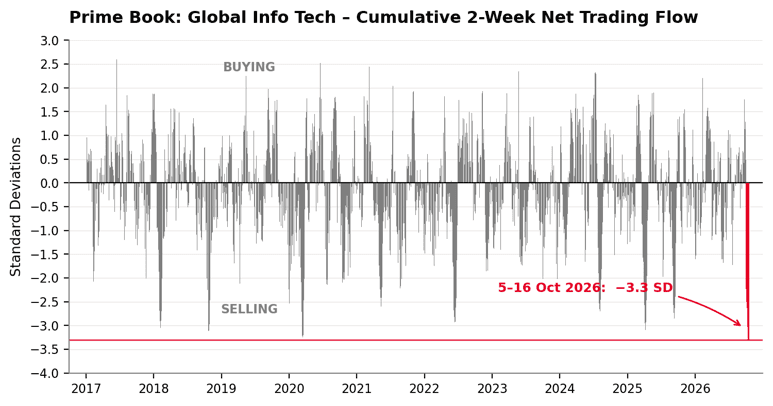
What the flow data tells us is that this has been an unusually mechanical episode rather than a considered one. Prime brokerage desks are reporting short positioning across the complex sitting at or close to the 99th percentile of its historical range, which is to say that the marginal seller over the past three weeks has been far more likely to have been a leveraged participant expressing a tactical view than a long-only holder revising a fundamental one.
The cumulative two-week net trading flow through prime books in global information technology paints a picture of similar severity. Over the 5th to 16th of October, net flow reached approximately 3.3 standard deviations below its mean, which places this episode alongside the most extreme bouts of de-risking recorded anywhere in the series since 2017 and comparable in magnitude to the fourth quarter of 2018 and the March 2020 dislocation. That reading was struck before the further leg lower the market took in the latter part of last week, with the consequence that the figures understate the full extent of the position unwind rather than overstate it.
Source: Prime brokerage data, period to 16 October 2026. Series reconstructed for illustrative purposes. Past performance is not indicative of future results.
We attach considerable weight to this. Flows of this magnitude and concentration are very rarely the product of a deliberate reassessment of long-term earnings power across an entire sector. They are instead the product of risk limits being respected, of gross exposure being reduced, and of momentum capital withdrawing from a crowded position more or less simultaneously. Episodes that begin in this fashion have historically shown a pronounced tendency to overshoot on the way down, and the recovery that follows has typically been driven by precisely the same mechanical forces operating in reverse once the selling pressure has exhausted itself.
OUR VIEW: A BALANCE SHEET STORY, NOT A DEMAND STORY |
Four considerations keep us constructive on the demand side even as financing conditions tighten appreciably for the weakest hands in the market.
Payback economics remain exceptionally short for well-capitalised builders, and this is in our view the single most important structural feature of the current build-out. SpaceX’s own disclosures offer the clearest illustration available: management has pointed to annual compute revenue potential of roughly $40 to $50 billion per gigawatt of installed capacity against construction costs of broadly the same order of magnitude, and stated on its most recent earnings call that new capital deployments into compute are now paying back in under a year. Set against economics of that character, the failure of any individual capacity owner represents a transfer of a productive asset rather than the destruction of one, because a well-funded buyer will invariably step in to take up infrastructure capable of repaying its cost within twelve months.
That precise dynamic played out in public only last week. Microsoft withdrew from a United Kingdom data centre commitment with the neocloud operator Nscale, and within a matter of days Nscale was reported to be in advanced discussions with Anthropic over a capacity agreement worth as much as $45 billion. Capacity released in this market is not sitting idle in search of a tenant; it is being absorbed by the next participant in a queue that remains considerably longer than the supply available to satisfy it.
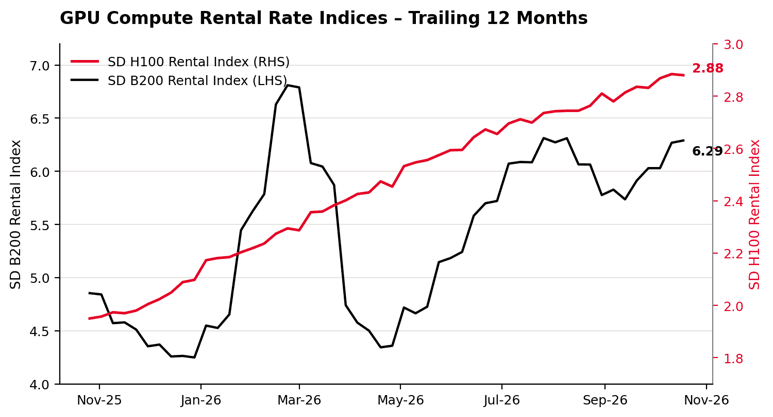
The underlying usage data has continued to compound throughout the drawdown without interruption. Token generation volumes are still growing at a rapid clip on a month-on-month basis, and GPU rental pricing, far from rolling over as one would expect to see in any genuine deterioration of demand, is trading at or close to all-time highs across both the H100 and the B200 generations.
The open versus closed source debate, which resurfaces periodically as a bear argument, does not alter the compute arithmetic in any way that matters to the hardware thesis. We set this out at length in Atoms to Intelligence: the majority of tokens generated will in all likelihood be open source on a volume basis, but a token is a token, and it consumes substantially the same compute, memory and networking resources regardless of which model happened to produce it. Open source capturing the larger share of future growth does not diminish the hardware opportunity in the slightest; if anything it broadens the universe of buyers competing for the same finite supply of infrastructure.
Source: Bloomberg (SDH100RT Index, SDB200RT Index), as at 22 October 2026. Indices reconstructed from Bloomberg terminal data for illustrative purposes. Past performance is not indicative of future results.
Taken together, we read the October move as a repricing of credit risk at the most leveraged edge of the neocloud cohort, amplified considerably by the unwind of a crowded position in a complex that had already travelled a long way. It is not, on our reading of the evidence available to us, a signal that the demand underpinning the AI infrastructure build-out has begun to deteriorate in any meaningful sense.
WHERE THIS LEAVES VALUATIONS |
The practical consequence of a drawdown of this severity is that it has done a great deal to reset valuations and remarkably little to alter the fundamental picture sitting beneath them. A number of businesses across the sub-sectors we favour are now changing hands at multiples we have not seen since considerably earlier in this cycle, notwithstanding order books, backlog disclosures and demand signals that have not deteriorated to anything approaching a corresponding degree. We regard this as an opportunity to build positions in companies we want to own through the next phase of the build-out, and our preferred expression of that view falls into three areas.
POSITIONING INTO THE DRAWDOWN |
Connectivity and networking is where we would concentrate incremental capital first. As AI clusters scale, the networking burden compounds along three axes at once: connecting a greater number of accelerators within a single server, which the industry terms scale-up; connecting a greater number of servers to one another, or scale-out; and connecting entire data centres to each other, or scale-across. Serving ever-larger inferencing workloads while continuing to train progressively larger models in line with the scaling laws makes each of these three problems harder simultaneously, which in our assessment renders networking one of the most structurally important and least adequately appreciated layers of the entire stack. The participants we are following within this theme include Credo, Lumentum, Celestica, Broadcom and Marvell.
Land, power and shell, which we group together under the heading LPS, remains an area in which we hold considerable conviction. These are the businesses responsible for assembling the physical foundation of a data centre long before a single accelerator is racked, encompassing the power infrastructure, the modular cooling and power shell assemblies, and the contractors who deliver and commission the whole of it. The attraction of this segment is that it sits furthest upstream of any individual chip generation and is accordingly rather better insulated from the product cycles that govern returns further down the stack. The participants we are following here include Bloom Energy, Vertiv, EMCOR and Vicor.
Compute and the equipment that produces it remains a long-term conviction for us, encompassing both the accelerators and central processors at the heart of the stack and the fabricators and wafer fab equipment manufacturers positioned to benefit from the extraordinary volume of new fab capacity being commissioned globally over the coming years. The participants we are following include Nvidia and Intel on the compute side, together with KLA Corporation, Lam Research and ASML among the equipment manufacturers.
Across all three areas our preference sits firmly with structurally advantaged businesses whose earnings growth is not a function of pricing. We are considerably more cautious on companies where the earnings base is driven principally by the pricing cycle, given how exposed that kind of business is to the new capacity additions that reliably follow any period of elevated returns. The companies named throughout this note are participants we are following within that framework rather than a list of recommendations, and any portfolio action remains subject to manager discretion and to client-specific suitability.